The Three Covenants
How the 1630s Pastors Built the American Mind.

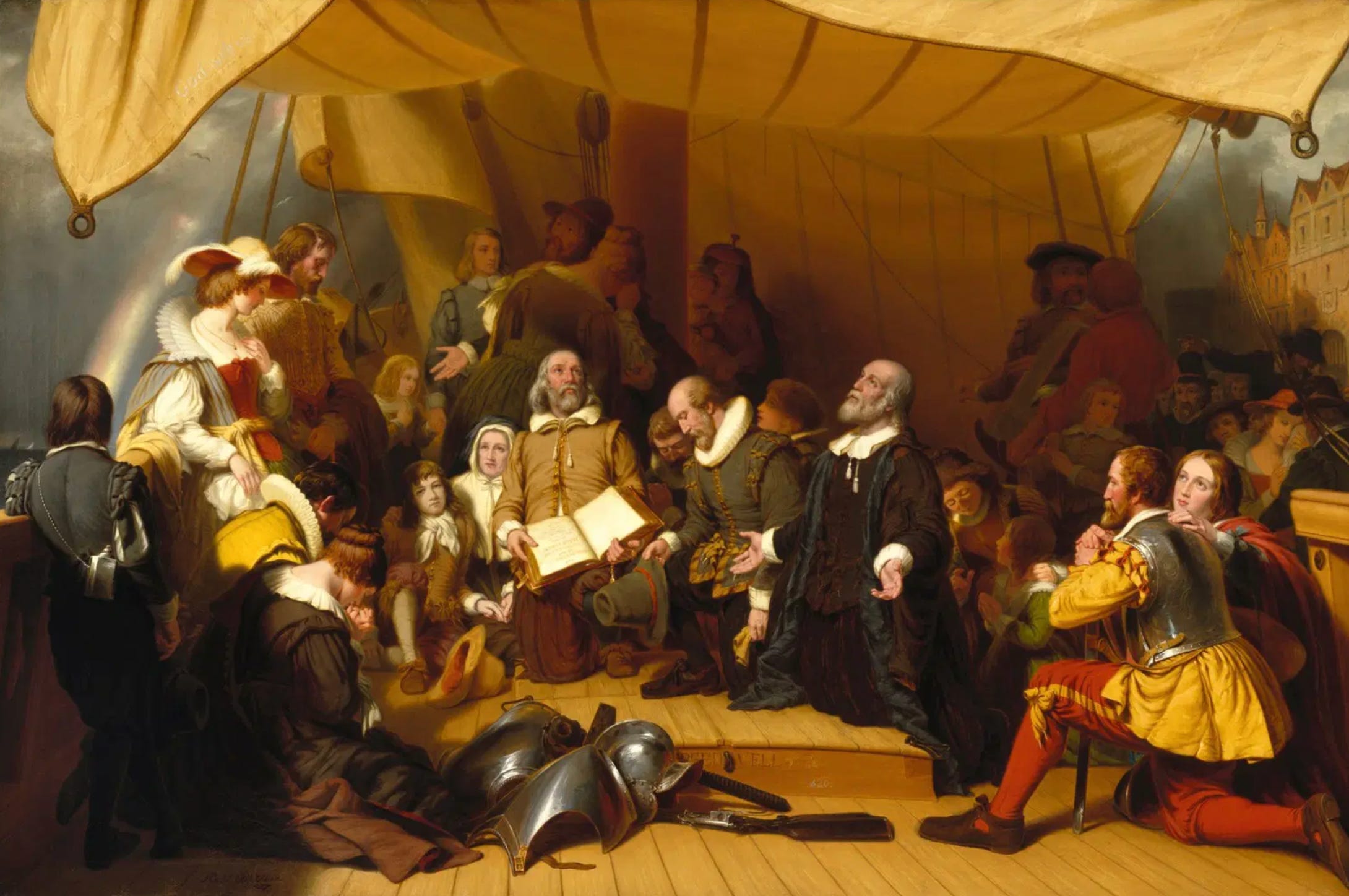
A man sat in a cabin on a ship called the Arbella in the spring of 1630 and wrote a sermon that has been quoted, misquoted, weaponized, and misunderstood for four centuries.
The sermon was a city on a hill. The man was John Winthrop. The argument has been buried under a phrase.
What Winthrop actually preached on the deck of that ship before the colony made landfall in the New World was a doctrine of covenanted government. The colony was bound to God by covenant. The magistrate was bound to the colony by covenant. If the colony kept the covenant, God would bless it. If the colony broke the covenant, the eyes of all people would be upon them and they would be made a story and a byword through the world.
This was not flattering rhetoric. It was a conditional contract with the God of heaven, preached to a few hundred men and women who were about to land on a continent where no king could reach them. They had crossed an ocean to build a polity under God without bishops in the chain of command and without a sovereign across the sea who could overrule the meetinghouse.
What they would build over the next fifteen years was not one model of covenanted government but three. Three pastors. Three sermons. Three colonial polities. Three competing theories of how a community is bound to God and how that binding relates to civil authority.
Those three covenants are the seed of every later American constitutional argument. This is the chapter the standard history skips.
The First Covenant: Winthrop and the Magistrate
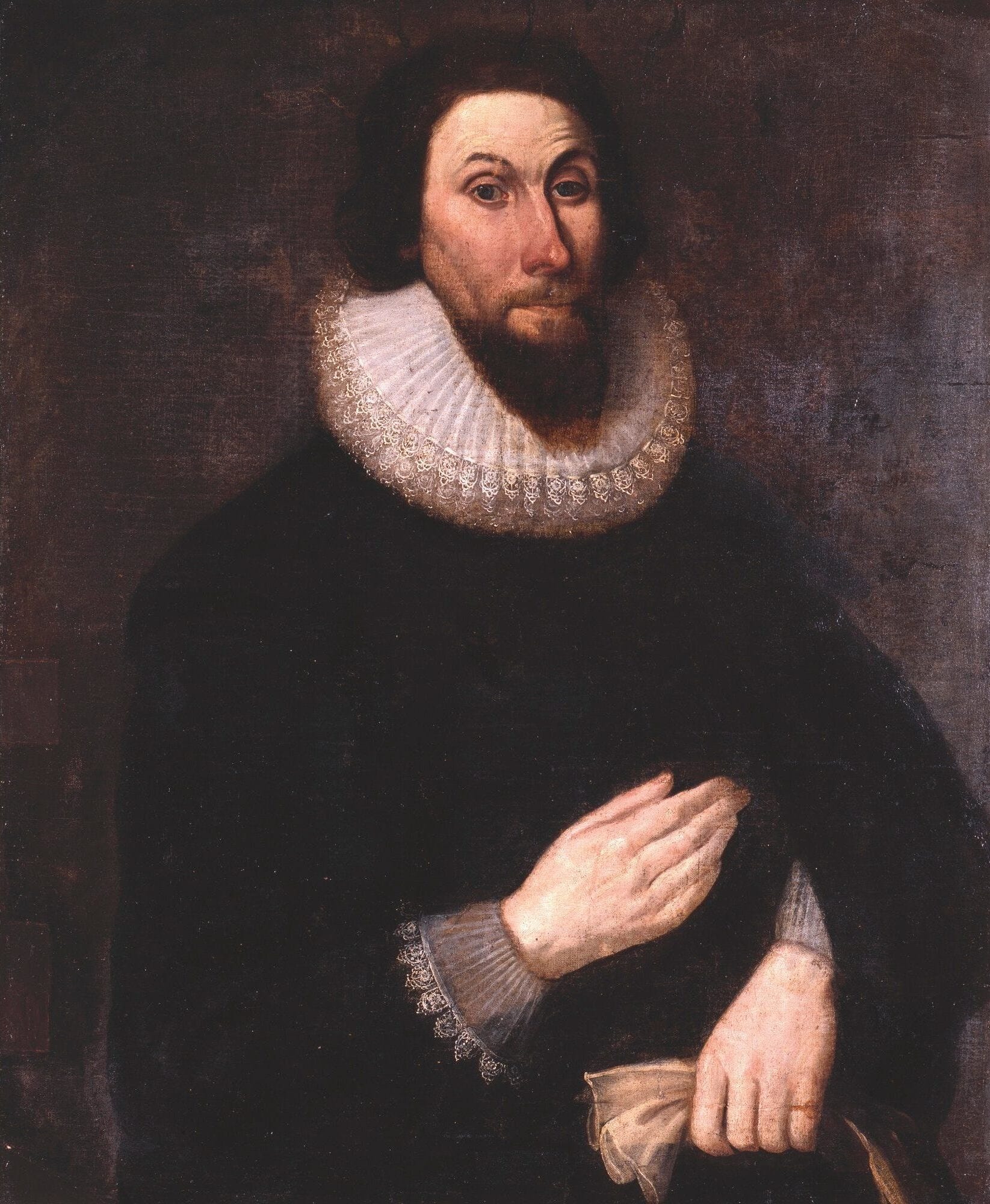
John Winthrop was forty-two years old when he stood on the deck of the Arbella. He was a Cambridge-trained lawyer, a Suffolk landowner, and the elected governor of a colony that did not yet have a coastline. He would serve as governor of Massachusetts Bay twelve times across the next nineteen years.
A Model of Christian Charity was preached in 1630 either on the ship before landfall or in Southampton just before sailing. The historical record is not perfectly clear on which. What is clear is that the men and women of the Massachusetts Bay Colony heard the sermon at the founding moment of their colonial experiment, and that the sermon set the terms of the experiment.
The sermon does the work in three movements.
First, Winthrop argues that God has ordained inequality among men by design. Some rich, some poor. Some powerful, some weak. This inequality exists so that men may have need of one another and may exercise the duties of mercy and justice that bind a community together. The inequality is not a license for the powerful to exploit the weak. It is a binding obligation.
Second, Winthrop argues that the colony is entering into a covenant with God. He uses the explicit language. We are entered into covenant with Him for this work. We have taken out a commission. The Lord hath given us leave to draw our own articles. If the colony keeps the articles, God will bless them. If the colony fails, God will withdraw the blessing and the colony will be made a story and a byword.
Third, Winthrop argues that the covenant binds the magistrate as well as the people. The magistrate is not above the covenant. The magistrate is a steward of the covenant before God. His authority is derived from the consent of the colony and from the ordination of God, and he answers to both.
This is the first covenant theory. Magistrate and people under God, in conditional relationship, with the magistrate as steward of the binding. The famous city on a hill phrase comes near the end of the sermon and means almost the opposite of what modern political rhetoric has made it mean. Winthrop is not promising American exceptionalism. He is warning that the world will be watching, and that failure will be visible to the world.
The Massachusetts Bay franchise was restricted to church members in full communion. The magistrate was elected by the church-member freemen. The polity was a civil-religious commonwealth in which the visible saints governed and the rest of the inhabitants lived under that governance.
It was the first colonial polity. It was not the only one. Within six years it would face a serious internal challenge.
The Second Covenant: Hooker and the People
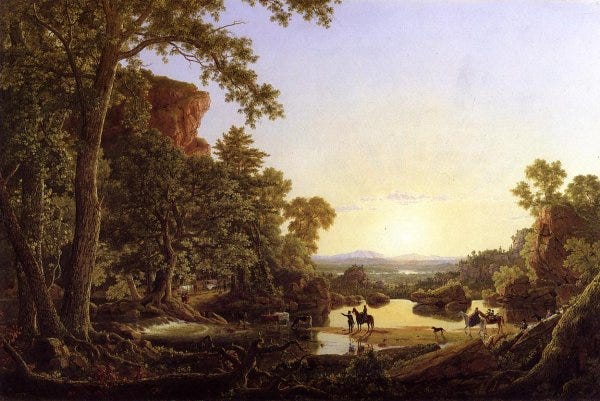
Thomas Hooker was forty-seven years old when he arrived in Massachusetts in 1633. He had been a leading Puritan preacher in England, had fled to Holland to escape arrest under Archbishop Laud, and had then sailed for the New World. He was a serious theologian, a powerful preacher, and a man with his own ideas about how a colony should be governed.
Hooker disagreed with Winthrop about the franchise. Winthrop and the Massachusetts Bay leadership had restricted the vote to full church members. Hooker believed the consent of the broader community was the proper foundation of magistracy. The disagreement was not academic. It was about who could vote and who could not.
In May 1636 Hooker led his congregation on foot through the wilderness from Newtown (now Cambridge) to the Connecticut River valley. They drove their cattle ahead of them. They carried their belongings on their backs. They walked roughly a hundred miles through unbroken forest. When they arrived they founded Hartford.
Two years later, on May 31, 1638, Hooker preached a sermon at Hartford to the General Court that would establish the theological foundation of the new colony. The text of the sermon survives only in notes taken by Henry Wolcott, but the key argument is recorded plainly. The foundation of authority is laid in the free consent of the people. The choice of public magistrates belongs unto the people by God’s own allowance. They who have power to appoint officers and magistrates have the power also to set the bounds and limitations of the power and place unto which they call them.
Read those sentences carefully. The foundation of authority is laid in the free consent of the people. They who have power to appoint officers also have the power to set the bounds and limitations of the power.
That is the doctrine of popular sovereignty. That is the doctrine of limited and accountable government. That is the doctrine Jefferson would put in the Declaration of Independence a hundred and thirty-eight years later when he wrote that governments derive their just powers from the consent of the governed.
Hooker preached it first.
On January 14, 1639, the freemen of Hartford, Wethersfield, and Windsor adopted the Fundamental Orders of Connecticut. The document is widely regarded as the first written constitution in the colonies that actually created a government. The first three articles establish the structure: a General Court, annual elections, governors limited to one-year terms, and a franchise that extended beyond strict church membership to include any admitted inhabitant who took the freeman’s oath.
The Fundamental Orders did not invoke the authority of the King of England. They did not invoke a colonial charter from London. They invoked the authority of God and the consent of the people who had bound themselves together. It was a colonial constitution written without reference to the crown.
The argument Hooker made in his sermon became a written government in seven months.
This was the second covenant theory. Covenant of all the people under God, with magistrates accountable to the broader body of the consented, with the franchise extended beyond strict religious test, and with the bounds of magistracy set by the people who appointed it.
The Third Covenant: Williams and the Conscience
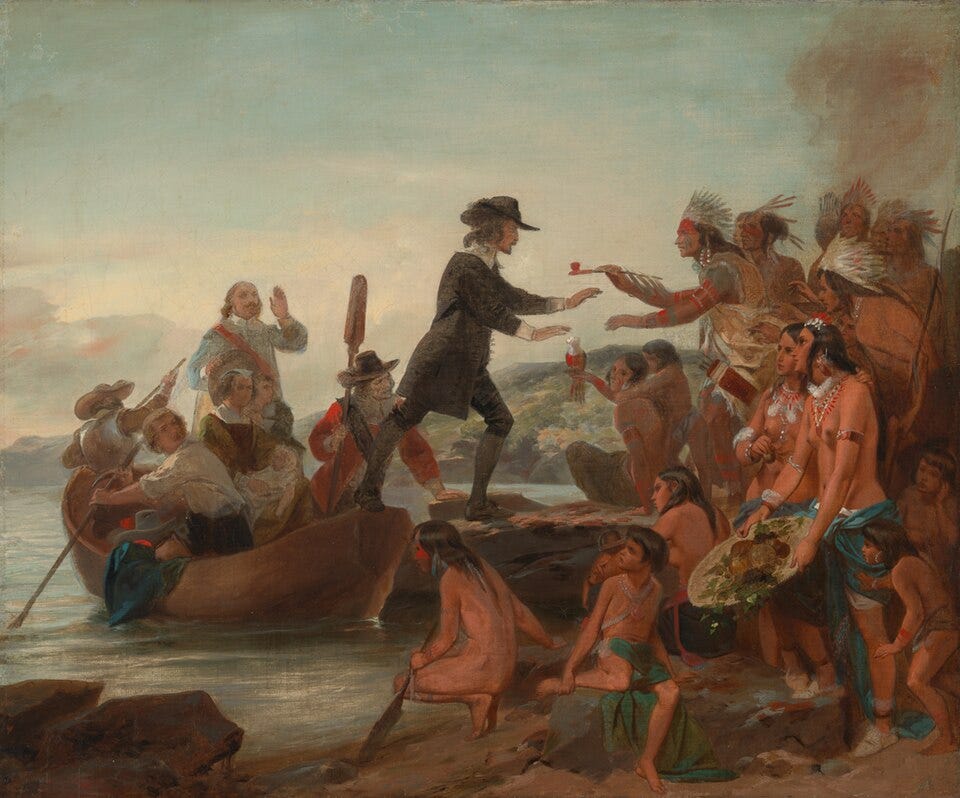
Roger Williams was about thirty-two years old when he was banished from Massachusetts Bay in October 1635. He had been the teacher at the Salem church. He had been a friend of Winthrop’s, despite their disagreements. He had argued that the magistrate had no authority over the religious conscience of the inhabitants, that the colony had no right to seize land from the Narragansett and Wampanoag peoples without purchase, and that the Massachusetts Bay charter from the King of England was based on a fraudulent claim to title.
The General Court of Massachusetts gave him six weeks to depart. Then the Bay Colony moved to arrest him and ship him back to England, where he would have faced imprisonment or execution.
In January 1636, Williams fled into the wilderness in the depth of a New England winter. He walked through fourteen weeks of snow. He survived because the Narragansett took him in. He had learned their language during his years in Salem and had treated them as men rather than as obstacles to be cleared. They sheltered him at Sowams. In the spring he founded Providence on land purchased from the Narragansett sachems Canonicus and Miantonomi.
Providence was unlike any other colonial polity. There was no religious test for inhabitants. The magistrate had no authority over religious belief or practice. The town meeting governed civil matters only. The conscience of every man was free before God.
Williams spent the next eight years working out the theology behind this arrangement. In 1644 he published The Bloody Tenent of Persecution in London. The book was an extended argument against the institutional coercion of religious belief, framed as a dialogue between Truth and Peace. The Bay Colony authorities had the book publicly burned. It went into multiple editions.
The argument was theological, not political. Williams was not a secularist. He was a Baptist of intense religious conviction. His argument was that the magistrate’s coercion of conscience violated the doctrine of the gospel, because faith cannot be coerced and must be the free response of the soul to the call of God. Any institution that compels religious belief produces hypocrites, not believers. The magistrate’s sword has no jurisdiction over the soul.
This was the third covenant theory. Covenant of the conscience under God alone, with the magistrate confined to civil matters and the soul protected from civil coercion.
The Bay Colony hated him. Cotton wrote against him. Winthrop, despite their personal friendship, defended his banishment. Williams was the first American to argue clearly for what would later be called religious liberty, and his contemporaries treated him as a dangerous heretic.
A hundred and fifty years later, James Madison would draft the First Amendment on essentially the argument Williams had made.
The Three Covenants and the American Argument
By 1645 the New England colonies had three working models of covenanted government in active operation. Massachusetts Bay was running Winthrop’s covenant. Connecticut was running Hooker’s covenant. Rhode Island was running Williams’ covenant. Each colony was preaching its own theology from its own pulpits, governing under its own constitution, and forming its own generations of inhabitants by its own model.
The differences mattered. Massachusetts restricted the vote to visible saints. Connecticut extended the franchise to admitted freemen across a religious spectrum. Rhode Island recognized no religious test at all. Massachusetts banished dissenters. Connecticut tolerated them within limits. Rhode Island welcomed them. Massachusetts read its civil authority as ordained by God to enforce religious as well as moral law. Connecticut read its civil authority as ordained by the consent of the people under God for civil purposes. Rhode Island read the magistrate’s authority as confined to civil matters with no jurisdiction over conscience.
These were not minor variations on a single theme. They were three competing theories of how a Christian community covenants itself before God and how that covenant relates to civil authority.
The American constitutional tradition is the long working out of these three covenants.
The Declaration of Independence is Hooker’s argument. The foundation of authority laid in the free consent of the people. Magistrates appointed by the people, with bounds set by the people, accountable to the people. Jefferson did not invent the doctrine. He inherited it from a Puritan pastor who had preached it in Hartford a century and a half earlier.
The First Amendment is Williams’ argument. The magistrate confined to civil matters. The conscience free before God alone. Religious belief outside the jurisdiction of the state. Madison and the framers did not invent religious liberty. They wrote into the Constitution what Williams had argued from the Providence town meeting in the 1640s.
The doctrine of the covenanted commonwealth, with the magistrate as steward under God, runs through both. That is Winthrop’s argument. The American magistrate is not a sovereign. He is a steward of a covenant that binds the people to God and to one another, and his authority is conditional on his fidelity to that covenant.
The three covenants together are the American constitutional theology. They were preached by three pastors in three colonial pulpits between 1630 and 1644. They were the formation tradition that built the American mind.
The Inheritance
The Election Sermon tradition that ran from 1634 to 1884 drew its theology directly from these three sources. Two and a half centuries of annual sermons preached before governors and legislatures, applying the doctrine of covenanted government to the moment, calling magistrates back to fidelity. The institution that the American mind cannot now name was the institution that carried Winthrop’s, Hooker’s, and Williams’ arguments forward across two hundred and fifty years.
The Great Awakening preachers a century later carried the same theology in revival register. The Black Robe Regiment in the 1770s carried it in resistance register. Jonas Clark at Lexington carried it to its harvest in the men who stood at dawn.
The argument was already in place a hundred years before the Stamp Act. The Revolution did not invent a new political theology. It applied a 140-year-old preached theology to the immediate question of the king and Parliament. The closing argument of the Declaration is the closing argument of a sermon the colonial pulpit had been preaching since Winthrop’s cabin on the Arbella.
The men who overthrew the king were the great-grandsons of the men who heard the three covenants preached in the 1630s. The formation came first. It always comes first.
What This Means for You
The American mind was built in the meetinghouse pulpit by three generations of pastors before any of the founders were born. The pulpit was the formation institution. The chamber came later. The legislature was the public face of a polity formed by the preaching.
Recover the meetinghouse and you recover the mind. The meetinghouse cannot be a museum or a metaphor. It has to be a working pulpit, preaching the covenant theology, applying the Word to the magistrate and the household and the conscience. That was the institution that built the republic. That was the institution that disappeared in the 19th century. That is the institution the next book argues must be recovered.
The texts have not changed. The Word has not changed. The arguments Winthrop and Hooker and Williams made still stand. The covenant theology they preached is still preachable. The pulpit they served is still buildable.
The mountains are still there.
Lift your head.
Value for Value
Three hundred and ninety-six years ago, three pastors crossed an ocean and built the formation tradition that would still be standing when their great-grandsons threw a king.
If this essay gave you something worth having, give something back. Send it to one man who needs to read it. Post it. Pass the argument forward. That is how the transmission works.
The book that started this platform is Forge the Son. The formation manual for fathers who understand that the home is the first republic and the father is its first magistrate.
Order on Amazon: https://a.co/d/0ezYbsTX
If you want to sustain this work through July 4 and beyond, become a paid subscriber. Every essay in this series is one argument built piece by piece toward the 250th anniversary of the Declaration.
The republic is rebuilt one household at a time.
Start yours.
~ Brett Hahn, AmRev Resurrected 🇺🇸
Brett Hahn is the founder of AmRev Resurrected and the author of Forge the Son: A Father’s Manual for Raising Sons by the Spirit That Built America.
amrevresurrected.com | @AmRevResurrect | amrevresurrected.substack.com
And again… another great writing and reminder of the faith that founded us and will continue to sustain us. Thanks Brett!